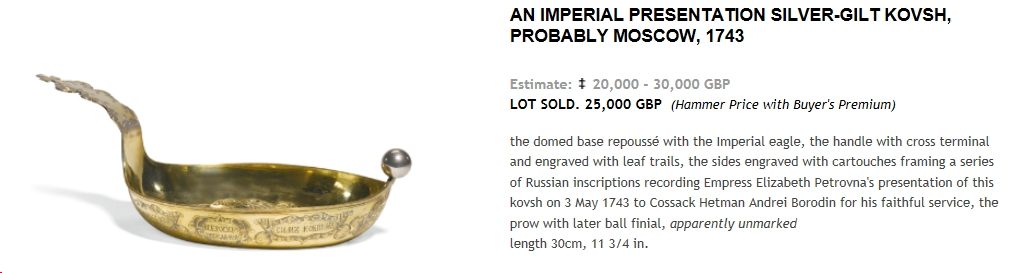
Danylo Apostol was presented a Kovsh by Peter the Great in gratitude for Danylo's outstanding service in the battle of Poltava on July 8, 1709. Czar Peter I of Russia engaged the army of King Charles XII of Sweden in what became the decisive engagement of the Great Northern War where the Swedes lost to the Russian army in large part due to the intervention of Danylo's cossacks in support of the Russians. In 1712 a blown glass Kovsh with gold gilt was presented Danylo. It remained in the family until the 1990s when it is believed that Andrew and Alexis donated it to a museum in Moscow or the Apostol Museum in Homutetz.
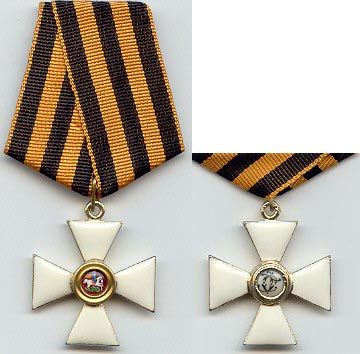
Matvei Mouravieff-Apostol was presented several Medals by Czar Alexander I. Following the Battle of Borodino fought on September 7, 1812 he was awarded the Order of St. Georges, 4th Class. Napoleon's invasion of Russia with some 130,000 soldiers was met 60 miles west of Moscow by 125,000 Russians under the command of General Kutuzov. The bloodiest conflict of the war between France and Russia resulted in some 80,000 casualties. At the time, Matvei was barely 20 years old. The Russian army was forced to withdraw leaving Moscow abandoned and burning to be seized by Napoleon a few weeks later. The award Badge of Distinction of the Military Order of St. George — commonly called the Soldier’s St. George Cross.Technically, Matvei was not awarded the officer’s Order of St. George, 4th Class. He received the enlisted-ranks’ Badge of Distinction for bravery at Borodino, chosen by the soldiers of his company. A replacement 4th-degree cross, No. 51802, was presented to him in 1883 after his right to wear it was restored.
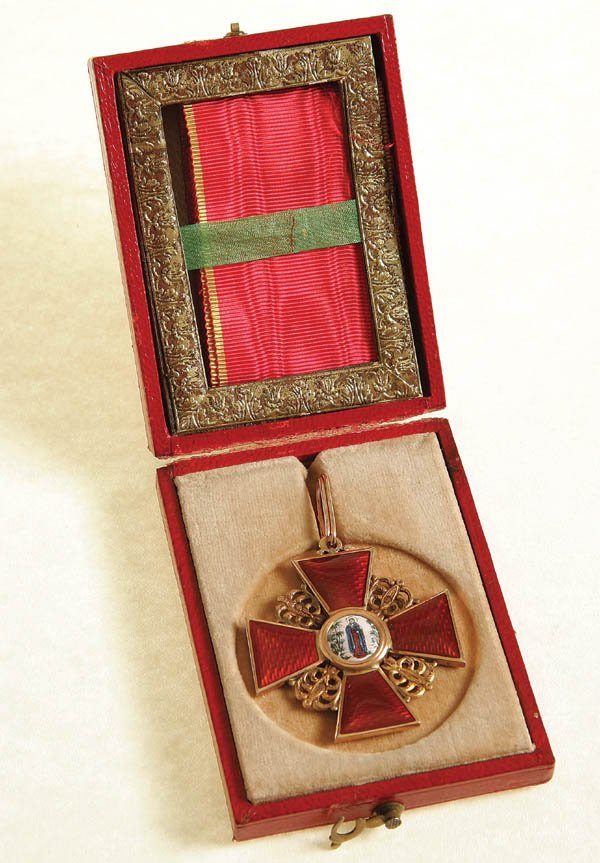
He would also receive the Imperial Order of St. Anne, 3rd Class under the 1813 classification—subsequently redesignated 4th Class; the “Anninsky weapon” award.
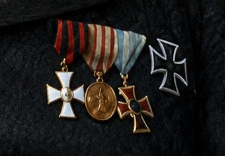 Military decorations associated with Matvei Ivanovich Mouravieff-Apostol: Badge of Distinction of the Military Order of St. George for Borodino; silver medal commemorating the Patriotic War of 1812; Order of St. Anne awarded for Kulm—then designated 3rd Class and subsequently reclassified as 4th Class; and the Prussian Kulm Cross for the Russian Guards, 1813. The present ribbons and mounting appear to be later replacements or a reconstructed arrangement.
Kulm Cross, also called the Prussian Badge of the Iron Cross for Kulm.
This is the separate black cross at the right. King Frederick William III of Prussia instituted it for Russian Guards troops who fought at the Battle of Kulm in 1813. Matvei was wounded there. The officer’s version was silver, black-lacquered on the front, and attached directly to the breast by a pin rather than suspended from a ribbon.
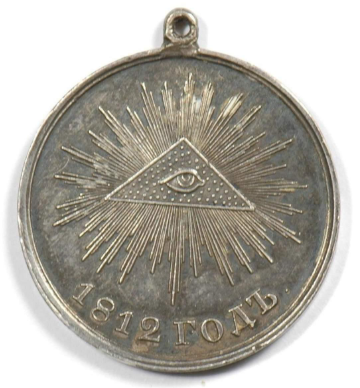
Silver Medal “In Memory of the Patriotic War of 1812.”
This is the round medal, second from left. Its face shows the Eye of Providence surrounded by rays, with “1812” below. It was normally worn from the light-blue ribbon of the Order of St. Andrew. Matvei’s ownership of this medal is specifically documented.
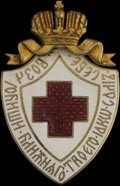
Vladimir Vladimirovitch Mouravieff-Apostol-Korobyine received several Medals for his service in the Diplomatic Corps and later he and his wife were awarded the Russian Red Cross Service Medal for their contributions during WWI. In 1905, the King of Portugal presented him with the Order of St. James. The decoration is properly known as the Military Order of Saint James of the Sword (Portuguese: Ordem Militar de Sant'Iago da Espada). Under the Portuguese monarchy, it was one of the kingdom's highest orders and was conferred upon Portuguese and foreign civilians for distinguished merit. The insignia consisted of a purple (violet) sash, a badge featuring the red Cross of Saint James, and, in the higher classes, an eight-pointed breast star